CCD Characteristics (see also
Plate Scale and Field of View)
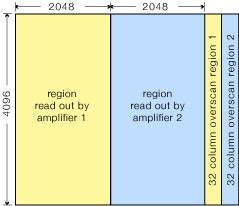
PFCam's detector is a back-illuminated, Fairchild 4096 x 4096 CCD with
15-micron square pixels.
Quantum Efficiency Plot (measured in the lab, Jamuary 2006;
opens in a new window).
Detector Characteristics for each readout mode
| binning | readout speed |
gain (e-/DN) |
readnoise (e-) |
readout time (m:ss) |
Linear to (DN) |
|---|---|---|---|---|---|
| x1 | slow | 1.3 | 11 | 2:40 | 55,000 |
| x1 | fast | 1.4 | 24 | 0:50 | 55,000 |
| x2 | slow | 1.2 | 3.5 | 0:45 | 64,000 |
| x2 | fast | 1.3 | 10 | 0:15 | 40,000 |
| x4 | slow | 1.2 | 3.1 | 0:15 | 60,000 |
| x4 | fast | 1.5 | 4.7 | 0:05 | 40,000 |
| NB: Bias level should be about 1000 DN for every readout mode. Measured on the telescope, August 2010 by E.Gates. | |||||
 More PFCam CCD specs and characeristics can be found on our detector
pages.
More PFCam CCD specs and characeristics can be found on our detector
pages.
Support Astronomers (sa@ucolick.org) Last modified: Tue Mar 8 18:46:42 PST 2011