CCD User Interface
The CCD User Interface (also called the Data-Taker) is started either by clicking
on its icon (labeled "Spect") or typing
nickel_spect_client at the Linux command line.
The interface consists of those software components for controlling the
direct-imaging camera's CCD, including setting array parameters, controlling
exposures, and displaying raw images:
- The CCD Control GUI, is pictured and described below.
- The XVideo Image Display and associated XVideo Image Control GUI
(common to most Lick data-taking systems) are described in a
separate manual.
Starting the CCD User Interface also invokes the
Motor Control GUI, described
in the
Motor Control section of this manual.
Click for a full-sized image in a separate window.
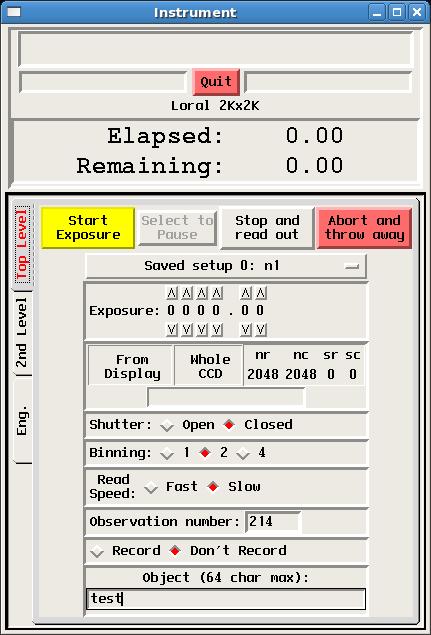

The top level of the GUI allows one to set various detector parameters
in advance, and to control exposures. Parameters are briefly described
here. Commands for controlling exposures - start, pause, stop, and
abort - are self explanatory.
Immediately below the
Quit button is the identification
of the CCD. For the Nickel Spectrograph the chip identification
should be
Reticon 400x1200. If it indicates another detector,
contact a support astronomer for assistance.
Saved Setup Parameters are stored as one of ten "saved
setups." No active "save" is required to make current parameters part of a
saved setup, instead, current parameters automatically become part of the
currently active saved setup. Saved setups may be named on the 2nd level of
the GUI (see below).
Exposure Time Zero-second exposures and fractional
seconds are allowed. Due to shutter timing errors and fly time, open
shutter exposures of less than 1 second for data are not recommended.
CCD Window This is the section of the CCD which is
atually read out. Smaller windows read out more quickly. The window
size may be defined graphically from the image display (using the
XVideo
b command to define the region), or by entering rows,
columns, and origin. Clicking "Whole CCD" restores readout of the whole chip.
Note that the XVideo display origin is the upper left hand corner of the image.
Shutter Open for normal exposure, close for darks and
bias frames.
Binning CCD9 is generally used unbinned for normal
observations (see
Detector Characteristics).
Read Speed Fast is about a third the time of slow, gained
at the price of an increase in readnoise (see
Detector Characteristics).
Observation Number and Recording The observation number
increments with each recorded exposure. It can be set manually, but
be careful, it is possible to overwrite existing data by setting the
number back. Note that the last unrecorded exposure is saved in
/scratch/nickel/scr.fits. More on
recording images in "2nd Level", below.
Object You may enter up to 64 characters, including white
spaces. The string will appear in the "OBJECT" field of the FITS header.
Click for a full-sized image in a separate window.
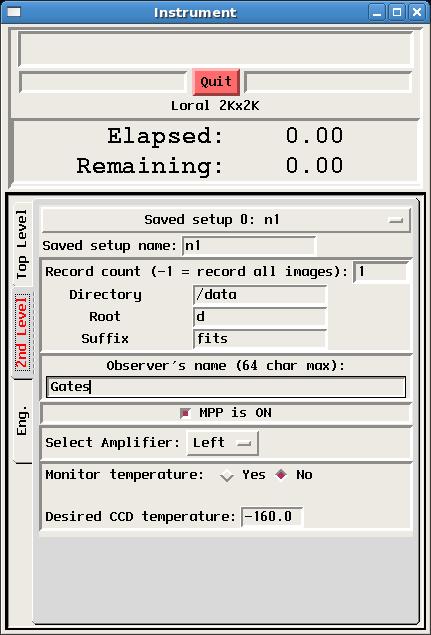
Clicking on the 2nd level tab on the GUI's left margin presents parameters
that are usually only set once in the course of a night, if at all. Only the
first few of these are for observer use. MPP and Amplifier selection should
remain as set by default, unless there is a clearly understood reason to change them.
Saved Setup Name This allows a name to be associated with a saved setup (see Top Level).
Record Count Whether an image is recorded or not is
controlled from the Top Level by turning recording on of off. The
record count parameter is generally set to 1 or -1 so that all
images are saved whenever recording is turned on.
Directory This parameter should be set to /data so that
recorded images are saved in the /data directory. It is important to
save them there so that they will be found and saved to Lick's on-line data archive,
http://mthamilton.ucolick.org/data/. Data are
copied to the archive shortly after being acquired. If you need to set or reset your data
archive password, please contact a Support Astronomer.
If there are data in the directory from a previous observer, contact a Support Astronomer
or Telescope Technician so they can confirm that data are properly in the archive before
clearing the directory for you. It is possible to overwrite data using the same observation
number, so do not take any recorded data or use observation numbers different from the existing
data until the data directory is properly cleared.
Root The string entered here becomes the root of the
image file names, prepended to a unique image number. E.g., using the
parameters shown here, the first recorded image will become
/data/d1.fits, the second d2.fits, and so on. The root may be
whatever you wish, but we recommend you use the default "d" root.
Suffix You may choose the suffix to be appended to your
image file names, but it must be one recognized by our automatic
archiver: fits, ccd, fts.
Observer's Name You may enter any number of first or
last names up to a total of 64 characters. White space and comma
separation are permitted. The string will appear in the "OBSERVER"
field of the FITS header.
Support Astronomers (sa@ucolick.org)
Last modified: Tue Jul 17 18:55:42 PDT 2012