Hamilton Throughput (with 3-meter and CAT)
The plots shown below give the full-system throughput (telescope plus spectrograph plus detector) as a percentage of the light incident on the primary mirrors of the 3-m and CAT telescopes. The plots are derived from standard star observations made using old dewar 8, a CCD that is no longer in use. The plots, which show overall performance with one of the two CCD's (dewar 6) currently available with the Hamilton, were extrapolated from the original measurements by comparing the QE's of old dewar 8 and dewar 6. Not given here are preformance curves for the second array currently available with the Hamilton: the LBL high-resistivity device now in dewar 8. Overall performance with the LBL device may be roughly estimated by comparing the CCD's relative QE's. See the Dewars and Detectors section of this manual. (When choosing the detector for your program, bear in mind that the two devices differ in several other characteristics besides QE.). Hamilton performance, particualarly with the 3-meter, is strongly seeing-dependent. The throughput measurements were made with a 4-arcsecond slit in 1 to 2 arcsecond seeing; the typical 3-meter observing slit is just over 1-arcsecond.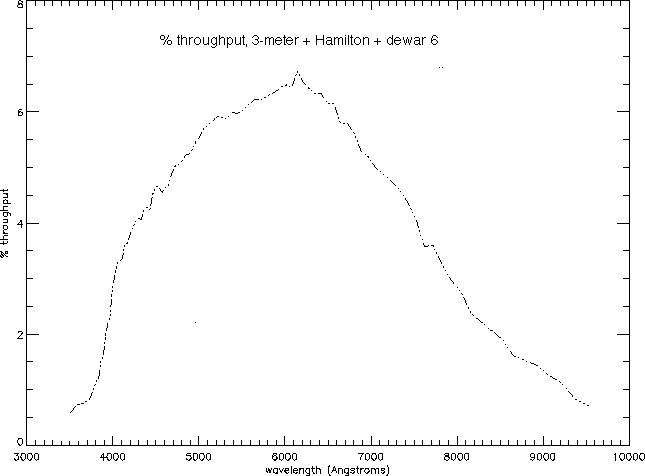
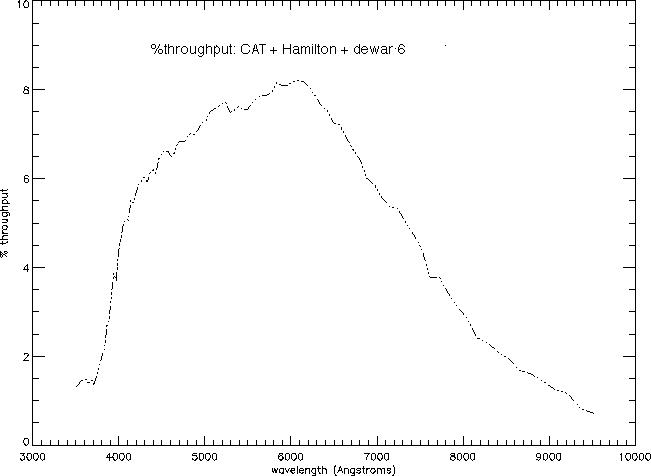 Note the change in the Y-axis scale of the CAT plot compared to the
3-meter plot.
The better relative performance of the CAT results from
the larger projected slit afforded by that telescope's more favorable plate
scale. (On a typical night, the CAT's performance is only about a factor
of seventeen less than the 3-meter's, rather than the factor of twenty-five
predicted by relative apertures alone.)
Note the change in the Y-axis scale of the CAT plot compared to the
3-meter plot.
The better relative performance of the CAT results from
the larger projected slit afforded by that telescope's more favorable plate
scale. (On a typical night, the CAT's performance is only about a factor
of seventeen less than the 3-meter's, rather than the factor of twenty-five
predicted by relative apertures alone.)
The throughput with the 3-m depends on whether you are observing in 3 mirror coude configuration or in the 5 mirror configuration. The throughput with the 5 mirror configuration is about 60% of the throughput of the 3 mirror configuration (which is shown above).